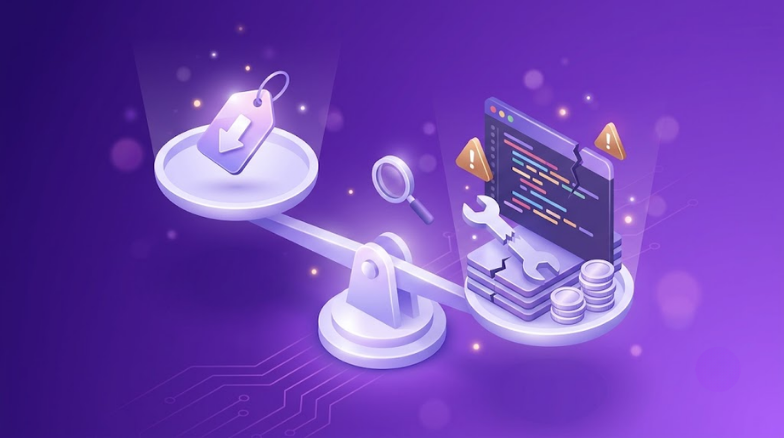
Every business owner wants a good website at a fair price, and there is nothing wrong with that. But when a quote is far lower than everyone else’s, it is worth asking how the work will be done. More and more low-cost services rely heavily on AI tools, and some hand over the output without checking it. The site can look finished on delivery day, and the real bill shows up months later. This guide explains where the hidden costs come from and how to hire wisely.
First, a Fair Point: Price Is Not the Problem
A lower price is not automatically a warning sign, and using AI is not a problem either. Skilled developers use AI tools to work faster, and some pass the savings on to their clients. The risk appears when nobody competent reviews, tests and understands what the AI produced. In that case, you are paying for code that has never been checked, and you are the one who carries the risk.
Where the Hidden Costs Come From
1. Rework
If the first version has bugs, security gaps or a poor structure, someone has to fix it. That means paying a second developer, often at a higher cost, because they must first work out how the existing code behaves before changing it. In some cases the cheapest option ends up being paid for twice.
2. Security incidents
Unreviewed code can contain missing input checks, weak access control or exposed keys. If it is exploited, the costs can include cleanup, lost data, downtime and damaged customer trust. See our guide on whether AI-generated code is secure for the most common risks.
3. Downtime and lost sales
A site that breaks during a campaign, a sale or a busy season costs more than the developer fee. Hidden bugs tend to appear exactly when traffic and pressure are highest.
4. Slow, expensive changes
Messy, duplicated code makes every later change slower and riskier. Adding a simple feature can take far longer than it should because the developer has to work around the existing structure. Over time, you pay more for each change.
5. Dependence on one person
If the original developer disappears, and nobody else can understand the project, you are stuck. A project with no documentation and no clear structure is hard to hand over.
6. Search and performance losses
A slow or poorly built site can hurt user experience and search visibility. That is a cost that does not show up on an invoice, but it affects how many customers find you.
7. Ownership and access problems
Some cheap arrangements leave you without full access to your own code, hosting, domain or accounts. Getting those back later can be difficult and sometimes expensive.
Red Flags When Hiring
- The price is far below every other quote, with no clear explanation.
- The developer cannot explain how they will build and test the project.
- There is no mention of testing, backups or security at all.
- They promise very fast delivery for a large or complex job.
- You will not get access to the code repository, hosting and admin accounts.
- They cannot show earlier work, or avoid questions about how it was built.
- They guarantee a perfect result or a site with “no bugs”.
- There is nothing about support or fixes after launch.
Questions to Ask Before You Hire
- Do you use AI tools in your work, and how do you check what they produce?
- Who will actually write and review the code?
- How do you test the site before launch?
- Will I own the code, hosting and all accounts from day one?
- Will you use version control, and will I get access to the repository?
- What documentation will I receive?
- What happens if something breaks after launch, and what does support cost?
- Can I see similar projects you have completed?
A good developer will be comfortable with these questions. Vague answers tell you something too.
How to Reduce Your Risk Without Overspending
- Compare scope, not just price. Make sure each quote covers the same features, testing, security and support.
- Start small. A small paid first stage lets you judge the quality before committing the full budget.
- Pay in stages tied to work you can see, rather than everything upfront.
- Insist on staging and backups. Changes should be tested on a copy before they go live.
- Get an independent review. If you already have a site, an AI code audit shows what you really have.
Already Hired Someone Cheap? Here Is What to Do
- Make sure you have your own access to the hosting, domain, admin area and code.
- Set up backups if they do not exist.
- Look for the warning signs in our list of 5 signs your AI-built website is not production-ready.
- Get an independent opinion on the code before you decide to keep paying for fixes.
- Decide with the facts whether to repair or rebuild. Our guide to fixing or rebuilding an AI-built website can help.
The Real Question Is Total Cost
The cost of a website is not only what you pay on day one. It includes fixes, security, maintenance, lost time and lost opportunity over the next few years. A fair price for work that is reviewed, tested and documented is often cheaper over time than a low price for work that is not. The goal is not to spend the most, but to know what you are buying.
Need a Second Opinion?
At Tech Contributors, we review AI-generated and cheaply built websites and apps, give an honest recommendation, fix what needs fixing, and offer ongoing maintenance. See our AI Code Audit & Fix service or contact us to talk about your project.